Pages

Showing posts with label Seven Wonders of the Ancient World. Show all posts

Friday, August 13, 2010

The Lighthouse of Alexandria - Seven Wonders of the Ancient World

The Lighthouse of Alexandria, also known as the Pharos of Alexandria, was a tower built between 280 and 247 BC on the island of Pharos at Alexandria, Egypt to guide sailors into the harbour at night. With a height variously estimated at between 393 and 450 ft (120 and 140 m), it was for many centuries among the tallest man-made structures, and was one of the Seven Wonders of the Ancient World.

Pharos was a small island just off the coast of Alexandria, which was connected to the mainland by a man-made causeway named the Heptastadion, which formed one side of the city's harbor. The tower erected on the island guided mariners at night using fire and reflective mirrors, and acted as a landmark by day. It was said that the light could seen from up to 29 miles (47 km) away, and legends claim that the light from Pharos could burn enemy ships before they reached shore.

Legend also holds that Ptolemy I Soter would not allow Sostratus to put his name on the tower, but the architect left the following inscription on the base's walls nonetheless:

Sostratus of Cnidus, son of Dexiphanes, to the Gods protecting those upon the sea.

These words were hidden under a layer of plaster, on top of which was chiseled another inscription honoring Ptolemy the king as builder of the Pharos. After centuries the plaster wore away, revealing the name of Sostratus.

The lighthouse was badly damaged in the earthquake of 956, and in the earthquakes of 1303 and 1323 was damaged to the extent that the Arab traveler Ibn Battuta reported no longer being able to enter the ruin. Even the stubby remnant disappeared in 1480, when the then-Sultan of Egypt, Qaitbay, built a medieval fort – the Citadel of Qaitbay – on the site of the lighthouse, using some of the fallen stone.


Constructed from large blocks of light-coloured stone, the tower was made up of three stages: a lower square section with a central core, a middle octagonal section, and, at the top, a circular section. At its apex was positioned a mirror which reflected sunlight during the day; a fire was lit at night. Extant Roman coins struck by the Alexandrian mint show that a statue of a triton was positioned on each of the building's four corners. A statue of Poseidon stood atop the tower during the Roman period. The Pharos' masonry blocks were interlocked, sealed together using molten lead, to withstand the pounding of the waves.

The fullest description of the lighthouse comes from the Arab traveller Abou Haggag Youssef Ibn el-Andaloussi, who visited the structure in 1165 AD:

The Pharos rises at the end of the island. The building is square, about 8.5 metres (28 ft) each side. The sea surrounds the Pharos except on the east and south sides. This platform measures, along its sides, from the tip, down to the foot of the Pharos walls, 6.5 metres (21 ft) in height. However, on the sea side, it is larger because of the construction and is steeply inclined like the side of a mountain. As the height of the platform increases towards the walls of the Pharos its width narrows until it arrives at the measurements above. ... The doorway to the Pharos is high up. A ramp about 183 metres (600 ft) long used to lead up to it. This ramp rests on a series of curved arches; my companion got beneath one of the arches and stretched out his arms but he was not able to reach the sides. There are 16 of these arches, each gradually getting higher until the doorway is reached, the last one being especially high.

Wednesday, August 11, 2010

Statue of Zeus at Olympia - Seven Wonders of the Ancient World

The Statue of Zeus at Olympia was made by the Greek sculptor Phidias, circa 432 BC on the site where it was erected in the Temple of Zeus, Olympia, Greece. It was one of the Seven Wonders of the Ancient World
The seated statue, some 12 meters (39 feet) tall, occupied the whole width of the aisle of the temple built to house it. "It seems that if Zeus were to stand up," the geographer Strabo noted early in the first century BC, "he would unroof the temple." The Zeus was a chryselephantine sculpture, made of ivory and gold-plated bronze. No copy in marble or bronze has survived, though there are recognizable but approximate versions on coins of nearby Elis and on Roman coins and engraved gems. A very detailed description of the sculpture and its throne was recorded by the traveler Pausanias, in the second century AD. The sculpture was wreathed with shoots of olive worked in gold and seated on a magnificent throne of cedarwood, inlaid with ivory, gold, ebony and precious stones. In Zeus' right hand there was a small statue of crowned Nike, goddess of victory, also chryselephantine, and in his left hand, a sceptre inlaid with gold, on which an eagle perched. Plutarch, in his Life of the Roman general Aemilius Paulus, records that the victor over Macedon, when he beheld the statue, “was moved to his soul, as if he had seen the god in person,” while the first century AD Greek orator Dio Chrysostom declared that a single glimpse of the statue would make a man forget all his earthly troubles.

The date of the statue, in the third quarter of the fifth century BC, long a subject of debate, was confirmed archaeologically by the rediscovery and excavation of Phidias' workshop.

According to a legend, when Phidias was asked what inspired him—whether he climbed Mount Olympus to see Zeus, or whether Zeus came down from Olympus so that Pheidias could see him—the artist answered that he portrayed Zeus according to Book One, verses 528 – 530 of Homer's IliadThe sculptor also was reputed to have immortalised his eromenos, Pantarkes, by carving "Pantarkes kalos" into the god's little finger, and placing a relief of the boy crowning himself at the feet of the statue


Temple of Artemis - Seven Wonders of the Ancient World

The Temple of Artemis (Greek: Ἀρτεμίσιον, or Artemision), also known less precisely as Temple of Diana, was a Greek temple dedicated to a goddess Greeks identified as Artemis that was completed, in its most famous phase, around 550 BC at Ephesus (in present-day Turkey). Though the monument was one of the Seven Wonders of the Ancient World, only foundations and sculptural fragments of the temple remain. There were previous temples on its site, where evidence of a sanctuary dates as early as the Bronze Age. The whole temple was made of marble except for the roof.
The temple antedated the Ionic immigration by many years. Callimachus, in his Hymn to Artemis, attributed the origin of the temenos at Ephesus to the Amazons, whose worship he imagines already centered upon an image. In the seventh century the old temple was destroyed by a flood. The construction of the "new" temple, which was to become known as one of the wonders of the ancient world, began around 550 BC. It was a 120-year project, initially designed and built by the Cretan architect Chersiphron and his son Metagenes, at the expense of Croesus of Lydia.

It was described by Antipater of Sidon, who compiled the list of the Seven Wonders:

I have set eyes on the wall of lofty Babylon on which is a road for chariots, and the statue of Zeus by the Alpheus, and the hanging gardens, and the colossus of the Sun, and the huge labour of the high pyramids, and the vast tomb of Mausolus; but when I saw the house of Artemis that mounted to the clouds, those other marvels lost their brilliancy, and I said, "Lo, apart from Olympus, the Sun never looked on aught so grand".


Tuesday, August 10, 2010

Colossus of Rhodes

The Colossus of Rhodes was a statue of the Greek god Helios, erected in the city of Rhodes on the Greek island of Rhodes by Chares of Lindos between 292 and 280 BC. It is considered one of the Seven Wonders of the Ancient World. Before its destruction, the Colossus of Rhodes stood over 30 meters (107 ft) high, making it one of the tallest statues of the ancient world

Alexander the Great died at the early age of 32 in 323 BC without having had time to put into place any plans for his succession. Fighting broke out among his generals, the Diadochi, with four of them eventually dividing up much of his empire in the Mediterranean area. During the fighting, Rhodes had sided with Ptolemy, and when Ptolemy eventually took control of Egypt, Rhodes and Ptolemaic Egypt formed an alliance which controlled much of the trade in the eastern Mediterranean.


Antigonus I Monophthalmus was upset by this turn of events. In 305 BC he had his son Demetrius Poliorcetes, also a general, invade Rhodes with an army of 40,000; however, the city was well defended, and Demetrius—whose name "Poliorcetes" signifies the "besieger of cities"—had to start construction of a number of massive siege towers in order to gain access to the walls. The first was mounted on six ships, but these capsized in a storm before they could be used. He tried again with a larger, land-based tower named Helepolis, but the Rhodian defenders stopped this by flooding the land in front of the walls so that the rolling tower could not move.


In 304 BC a relief force of ships sent by Ptolemy arrived, and Demetrius's army abandoned the siege, leaving most of their siege equipment. To celebrate their victory, the Rhodians sold the equipment left behind for 300 talents and decided to use the money to build a colossal statue of their patron god, Helios. Construction was left to the direction of Chares, a native of Lindos in Rhodes, who had been involved with large-scale statues before. His teacher, the sculptor Lysippos, had constructed a 22 meter (70 ft) high bronze statue of Zeus at Tarentum.


Monday, August 9, 2010

Hanging Gardens of Babylon - Seven Wonders of the Ancient World


The Hanging Gardens of Babylon are considered to be one of the original Seven Wonders of the Ancient World. They were built in the ancient city-state of Babylon, near present-day Al Hillah, Babil, in Iraq. They are sometimes called the Hanging Gardens of Semiramis (in reference to the legendary Queen Semiramis).

The gardens were built by the Babylonian king Nebuchadnezzar II around 600 BC. He is reported to have constructed the gardens to please his homesick wife, Amytis of Media, who longed for the trees and fragrant plants of her homeland Persia. The gardens were destroyed by several earthquakes after the second century BC.

The lush Hanging Gardens are extensively documented by Greek historians such as Strabo and Diodorus Siculus. Through the ages, the location may have been confused with gardens that existed at Nimrud, since tablets from there clearly show gardens. Writings on these tablets describe the possible use of something similar to an Archimedes screw as a process of raising the water to the required height. Nebuchadnezzar II also used massive slabs of stone, which was unheard of in Babylon, to prevent the water from eroding the ground.


"Babylon, too, lies in a plain; and the circuit of its wall is three hundred and eighty-five stadia. The thickness of its wall is thirty-two feet; the height thereof between the towers is fifty cubits; that of the towers is sixty cubits; the passage on top of the wall is such that four-horse chariots can easily pass one another; and it is on this account that this and the hanging garden are called one of the Seven Wonders of the World. The garden is quadrangular in shape, and each side is four plethra in length. It consists of arched vaults, which are situated, one after another, on checkered, cube-like foundations. The checkered foundations, which are hollowed out, are covered so deep with earth that they admit of the largest of trees, having been constructed of baked brick and asphalt — the foundations themselves and the vaults and the arches. The ascent to the uppermost terrace-roofs is made by a stairway; and alongside these stairs there were screws, through which the water was continually conducted up into the garden from the Euphrates by those appointed for this purpose. For the river, a stadium in width, flows through the middle of the city; and the garden is on the bank of the river."

"The Garden was 100 feet (30 m) long by 100 ft wide and built up in tiers so that it resembled a theatre. Vaults had been constructed under the ascending terraces which carried the entire weight of the planted garden; the uppermost vault, which was seventy-five feet high, was the highest part of the garden, which, at this point, was on the same level as the city walls.The roofs of the vaults which supported the garden were constructed of stone beams some sixteen feet long, and over these were laid first a layer of reeds set in thick tar, then two courses of baked brick bonded by cement, and finally a covering of lead to prevent the moisture in the soil penetrating the roof. On top of this roof enough topsoil was heaped to allow the biggest trees to take root. The earth was leveled off and thickly planted with every kind of tree. And since the galleries projected one beyond the other, where they were sunlit, they contained conduits for the water which was raised by pumps in great abundance from the river, though no one outside could see it being done."

Saturday, August 7, 2010

Mausoleum at Halicarnassus or Tomb of Mausolus - Seven Wonders of the Ancient World


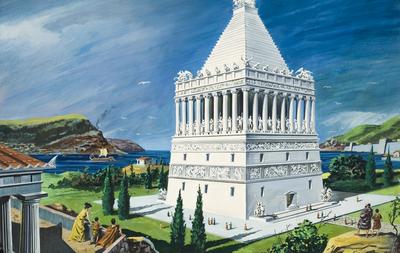
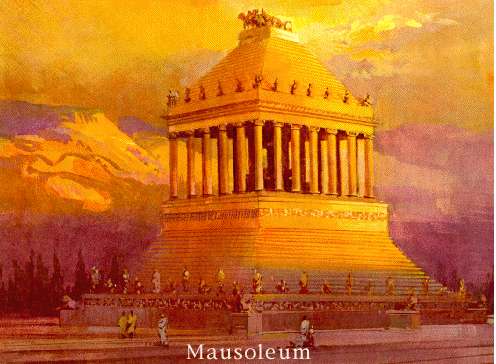
The Mausoleum at Halicarnassus or Tomb of Mausolus (in Greek, Μαυσωλεῖον τῆς Ἁλικαρνασσοῦ) was a tomb built between 353 and 350 BC at Halicarnassus (present Bodrum, Turkey) for Mausolus, a satrap in the Persian Empire, and Artemisia II of Caria, his wife and sister. The structure was designed by the Greek architects Satyros and Pythis. It stood approximately 45 m (148 ft) in height, and each of the four sides was adorned with sculptural reliefs created by each one of four Greek sculptors — Leochares, Bryaxis, Scopas of Paros and Timotheus.The finished structure was considered to be such an aesthetic triumph that Antipater of Sidon identified it as one of his Seven Wonders of the Ancient World.

The word mausoleum has since come to be used generically for any grand tomb.


623 BC, Halicarnassus was the capital of a small regional kingdom in the coast of Asia Minor. In 377 BC the ruler of the region, Hecatomnus of Milas, died and left the control of the kingdom to his son, Mausolus. Hecatomnus, a local satrap under the Persians, took control of several of the neighboring cities and districts. After Artemisia and Mausolus, he had several other daughters and sons: Ada (adopted mother of Alexander the Great), Idrieus and Pixodarus. Mausolus extended its territory as far as the southwest coast of Anatolia. Artemisia and Mausolus ruled from Halicarnassus over the surrounding territory for twenty-four years. Mausolus, although descended from local people, spoke Greek and admired the Greek way of life and government. He founded many cities of Greek design along the coast and encouraged Greek democratic traditions.

Mausolus decided to build a new capital; a city as safe from capture as it was magnificent to be seen. He chose the city of Halicarnassus. If Mausolus' ships blocked a small channel, they could keep all enemy warships out. He started to make of Halicarnassus a capital fit for a warrior prince. His workmen deepened the city's harbor and used the dragged sand to make protecting breakwaters in front of the channel. On land they paved streets and squares, and built houses for ordinary citizens. And on one side of the harbor they built a massive fortified palace for Mausolus, positioned to have clear views out to sea and inland to the hills — places from where enemies could attack.

On land, the workmen also built walls and watchtowers, a Greek–style theatre and a temple to Ares — the Greek god of war.

Artemisia and Mausolus spent huge amounts of tax money to embellish the city. They commissioned statues, temples and buildings of gleaming marble. In the center of the city Artemisia planned to place a resting place for her body, and her husband's, after their death. It would be a tomb that would forever show how rich they were.

In 353 BC Mausolus died, leaving Artemisia broken-hearted. It was the custom in Caria for rulers to be siblings; such incestuous marriages kept the power and the wealth in the family. As a tribute to him, she decided to build him the most splendid tomb, a structure so famous that Mausolus's name is now the eponym for all stately tombs, in the word mausoleum. The construction was also so beautiful and unique it became one of the Seven Wonders of the Ancient World.

Soon after construction of the tomb started, Artemisia found herself in a crisis. Rhodes, a Greek island at the Aegean Sea, had been conquered by her and Mausolus. When the Rhodians heard about her husband's death, they rebelled and sent a fleet of ships to capture the city of Halicarnassus. Knowing that the Rhodian fleet was on the way, Artemisia hid her own ships at a secret location at the east end of the city's harbor. After troops from the Rhodian fleet disembarked to attack, Artemisia's fleet made a surprise raid, captured the Rhodian fleet and towed it out to sea. Artemisia put her own soldiers on the invading ships and sailed them back to Rhodes. Fooled into thinking that the returning ships were their own victorious navy, the Rhodians failed to put up a defense and the city was easily captured, quelling the rebellion.

Artemisia lived for only two years after the death of her husband. The urns with their ashes were placed in the yet unfinished tomb. As a form of sacrifice ritual the bodies of a large number of dead animals were placed on the stairs leading to the tomb, then the stairs were filled with stones and rubble, sealing the access. According to the historian Pliny the Elder, the craftsmen decided to stay and finish the work after the death of their patron "considering that it was at once a memorial of his own fame and of the sculptor's art."